
What do airline accessibility services cover, and what don't they?
by Magni Magnason
Canadian airlines are required to provide accessibility support, including wheelchair assistance, priority boarding, help with mobility aids and, with advance notice, assistance boarding and making connections. That support only goes so far: it does not include staying with one traveller, personal care, medications or health monitoring. Travellers who need more can add a Travel Companion or Medical Escort for the journey.
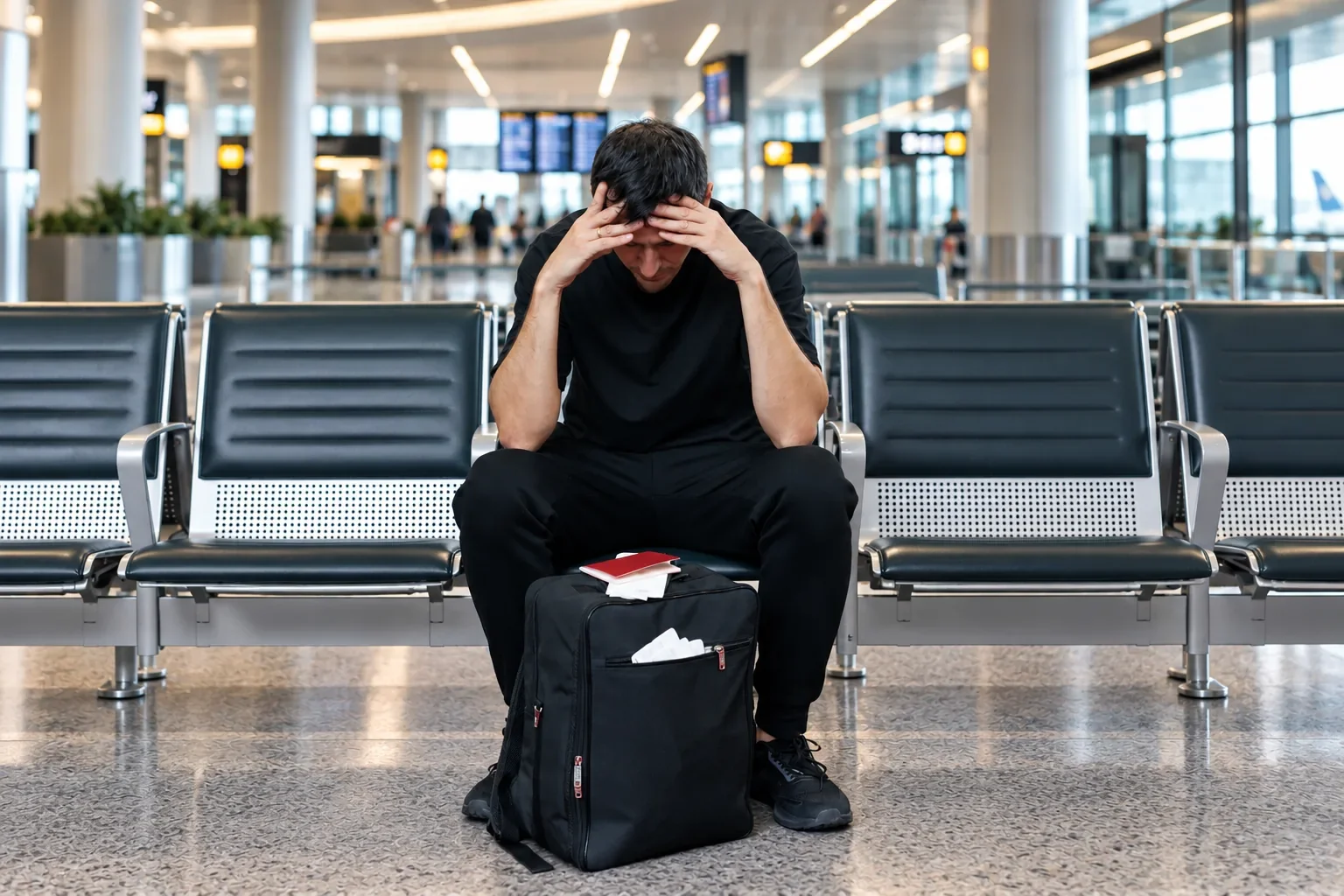
A lone traveler waiting to board an airplane.
What do airline accessibility services include?
In Canada, the services a large airline must provide are set out in the Accessible Transportation for Persons with Disabilities Regulations, administered by the Canadian Transportation Agency (CTA). Most airlines offer more than the minimum, but the regulations are a reliable baseline for what any traveller can expect.
Some services are provided on request at the airport, without advance notice: help at check-in and with carry-on baggage, transfers to and from a mobility aid, a description of the cabin layout for travellers with low vision, individual safety briefings, help opening packaging and describing meals, assistance to and from the washroom using an on-board wheelchair, and periodic check-ins during the flight.
Other services must be requested at least 48 hours before departure, and the airline may ask for up to 96 hours if it needs documents to assess the request. These include assistance boarding and disembarking, help through security and border control, an on-board wheelchair, retrieval of checked baggage, and seating for a support person or a service dog. The CTA's guide to advance notice lists both groups in full: Advance Notice and Supporting Documentation: A Guide.
Two practical points follow from this. The 48-hour window is a minimum, not a target; requesting services when you book is the only way to be sure they are scheduled. And the services are tied to the airline you fly with, so on an itinerary with two carriers, each one typically needs its own request.
What can airline staff not do?
Airline and airport staff are responsible for every passenger on the flight. Accessibility assistance is delivered within that responsibility, in defined segments: at the counter, through the terminal to the gate, onto the aircraft, and off again at the other end. Between those segments, and during a layover, the traveller is usually on their own.
In practice, airline staff generally cannot remain with one traveller throughout the airport, supervise a traveller during a connection, assist with personal care, manage or administer medications, monitor a health condition, make decisions about a traveller's care, or leave their assigned duties to accompany one passenger through every stage of the trip. The regulations themselves say nothing requires a carrier to do anything that jeopardizes safety, and that operational factors can limit what is possible on the day.
None of this is a shortfall in commitment. It is the design of a system built to move many people safely, and it works well for the majority of travellers with a disability. It is also why the gaps matter for the minority who need more.
Can a support person fly free under "One Person, One Fare"?
Sometimes. Canadian regulations require large airlines to provide an adjacent seat for a support person when a traveller's disability means they need help during the flight itself. On domestic flights that seat must be provided without charge, a requirement the Canadian Transportation Agency calls One Person, One Fare. On international flights the airline may charge for it. The airline decides whether a traveller qualifies, usually on the basis of medical documentation, and the request needs advance notice. The CTA's guide sets out the rule: Additional Seating and the One Person, One Fare Requirement.
The rule covers the seat, not the person; the airline does not supply the support person. Where it applies to a traveller's situation, Portage can help with the request as part of planning the trip.
When are airline accessibility services all you need?
Often. A traveller who can manage their own medications, is comfortable being alone at the gate and during a layover, and mainly needs help covering distance in the terminal and getting on and off the aircraft is usually well served by the airline's own assistance, requested in advance. The same is true for many wheelchair users, travellers with hearing or vision loss, and people with a stable condition who have flown before and know what the day involves.
The honest test is the time between the assistance segments. If the traveller would be fine sitting alone at a departure gate for ninety minutes, and fine again if the flight were delayed by three or more hours, the airline's services are probably enough.
When does a traveller need someone for the whole journey?
The concern families and referring professionals describe is rarely the distance to the gate. It is everything else: a traveller with early dementia becoming disoriented during a connection, someone with Parkinson's needing steady help across a long travel day, a person recently discharged from hospital who tires by the second airport, an older adult with limited mobility flying alone for the first time in years, or someone who becomes anxious the moment a plan changes. Sometimes the traveller raises the concern themselves.
In those situations the useful measure is continuity. A Portage Travel Companion or Medical Escort is there to support the traveller in front of them, from pickup through check-in, security, the gate, the flight, any connection, baggage claim and ground transport, until the journey ends, whether that is a family member's door, a hotel check-in, or a receiving facility. If a flight is delayed, cancelled or diverted, or a connection is missed, the companion is still there and the Case Coordinator rebooks around the traveller rather than the traveller navigating it alone. This kind of support is also recognised in the accessibility data: in the Chief Accessibility Officer's 2025 report, 76 per cent of people with disabilities who took an out-of-town trip travelled by air, and 47 per cent of those who travelled encountered a barrier along the way (Office of the Chief Accessibility Officer, Annual Report 2025).
When is a Medical Escort, or an air ambulance, the right level?
Some travellers need more than practical support. If someone requires clinical observation, oxygen management, medication administration or ongoing assessment during travel, a Medical Escort, a nurse or paramedic who travels with them on a commercial flight, is the appropriate level. The journey itself is the same kind of journey a Travel Companion supports, door to door; what changes is the level of clinical care along the way. Medical Escort trips span the full range: getting home from a hospital abroad, moving between two hospitals, relocating to a care facility closer to family, or any trip where safe travel requires active medical accompaniment.
An air ambulance is not the only option for a traveller with medical needs, and it is rarely the first one. Many travellers with significant health conditions travel safely on a commercial airline with the right planning and the right person beside them, and some are better served by ground transport with the same care aboard. The right answer depends on the traveller, not on the most intensive option available. Where an air ambulance is necessary, that is what should be recommended; where commercial travel can be done safely with support, that should be explained just as plainly.
Where Portage fits
Portage supports the journey itself, from departure to arrival, at one of two levels. A Travel Companion provides practical, continuous support for a traveller whose health, disability or mobility makes travelling alone difficult. A Medical Escort provides a higher level of clinical care during the trip, including clinical interventions when they are needed. Our intake process determines which level a traveller needs, and we will say so before anything is booked..
