
Can I fly with oxygen, and how do I arrange it?
by Magni Magnason
Yes, with planning. Air Canada and WestJet no longer supply oxygen on board or allow cylinders in the cabin, so a portable oxygen concentrator the airline has approved, with medical clearance before the flight, is the only option. International airlines set their own rules, and a journey across two carriers needs each one's approval. Portage coordinates the approvals and can arrange the concentrator.
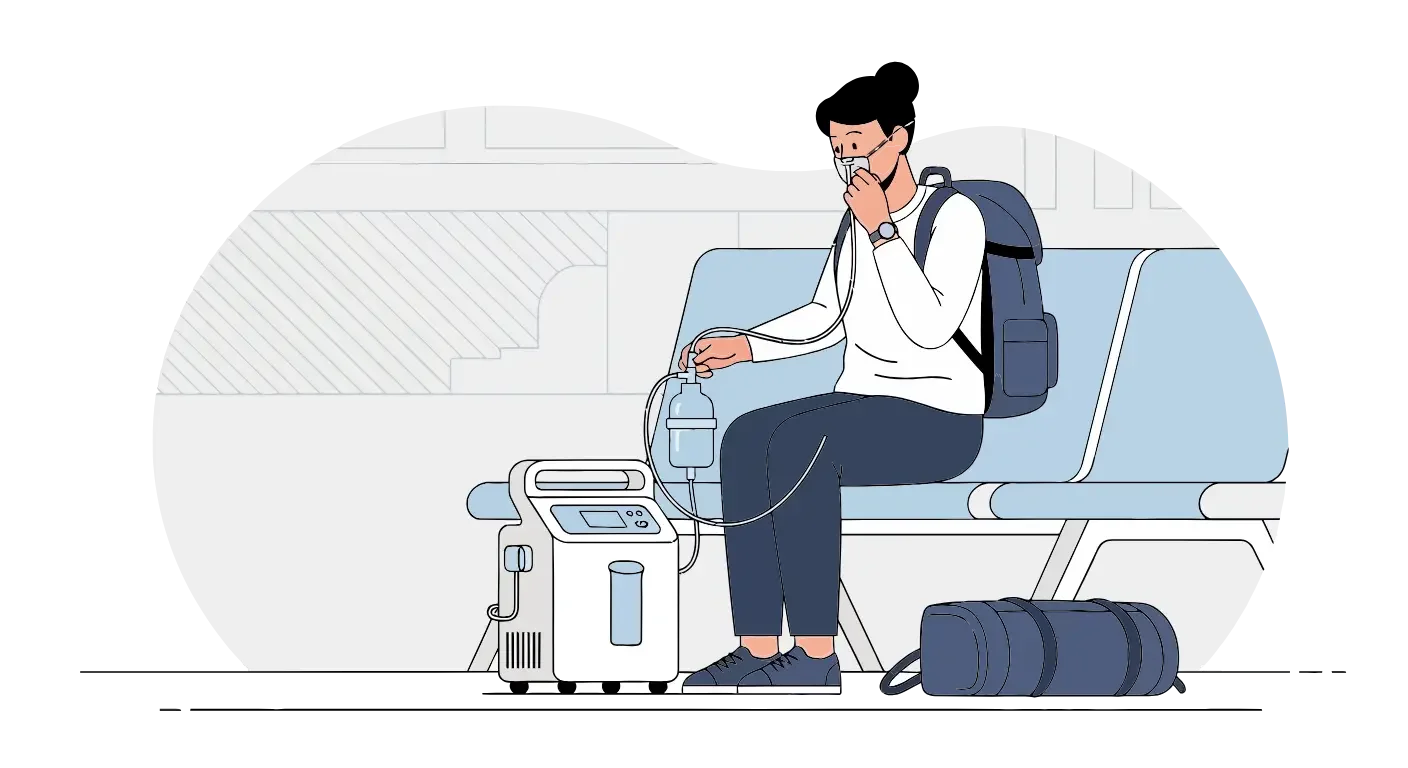
Why might I need oxygen in the air when I don't need it on the ground?
Because the cabin is not at ground level. A commercial aircraft cabin is pressurised to a cabin altitude of up to about 2,400 metres, or 8,000 feet, and at that altitude the amount of oxygen reaching the blood drops. A healthy passenger never notices. A traveller with COPD or another chronic lung condition, heart failure, severe anaemia, or a recent respiratory illness may.
That is why three different groups of people end up planning for oxygen on a flight: people who already use oxygen at home and need a travel setting for the cabin; people who manage well on the ground but whose physician advises oxygen for the flight only; and people recovering from pneumonia, surgery or a long hospital stay whose oxygen levels have not yet returned to normal. WestJet's own guidance notes that a traveller already on oxygen at rest is commonly advised to increase the flow rate in flight.
Whether you need oxygen in flight, and at what setting, is a decision for your physician. It is worth raising with them before anything is booked if you use oxygen at home, have a chronic lung or heart condition, have recently had pneumonia or a hospital stay, or become short of breath with light activity.
Can I bring my own oxygen cylinder on a Canadian flight?
No. Neither Air Canada nor WestJet permits compressed or liquid oxygen cylinders for passenger use in the cabin, and neither airline supplies oxygen on board any longer.
For many years Air Canada offered an onboard oxygen service, called Medipak, that travellers booked and paid for in advance. That service was retired on 26 September 2026. Air Canada now supports travellers in using a portable oxygen concentrator instead, their own or a rented one. WestJet does not sell oxygen and states that it accepts only portable oxygen concentrators for use on any flight where oxygen is required. Canned or recreational oxygen is not accepted in carry-on or checked baggage on either airline.
So the practical answer for a Canadian domestic or transborder flight is a single one: a portable oxygen concentrator, or POC. A POC is a battery-powered device that draws oxygen from the cabin air rather than storing it, which is why it is permitted where cylinders are not.
The home equipment most people already have does not fill the gap. Oxygen tanks cannot board, and a home concentrator is a mains-powered unit the size of a small suitcase, not an approved in-flight device. A POC is a different piece of equipment, and for most travellers it is one they will use for the trip and return afterwards.
How do I get approval to use a portable oxygen concentrator on Air Canada or WestJet?
The process is the same in outline on both airlines. Using a POC in flight requires medical approval from the airline, and that approval starts with a medical form completed by your physician and submitted to the airline's medical desk. Each airline then reviews it against its own requirements for the device, the batteries and the traveller, and confirms the approval before the flight.
The details differ. Air Canada asks that you contact its Accessibility Services at least 48 hours before departure and have approval in place before travel; the POC has to be a model on Air Canada's approved list, and you bring battery for 1.5 times your total travel time. WestJet recommends submitting the physician's form ten business days before departure. A POC on WestJet's approved list, or carrying the manufacturer's label confirming it meets FAA acceptance criteria, can be used during all phases of flight, while other POCs may only be used at cruise; batteries, including spares, may not exceed 100 watt-hours each, spares travel in carry-on only, and WestJet also uses 1.5 times total travel time as the battery standard. On both airlines the device stays under the seat in front of you and you need to be able to operate it without assistance.
Two things catch people out. First, "total travel time" means the whole journey, not the flight: time at the airport before departure, the flight, any connection, and a margin for delay. Aircraft seat power cannot be used to run or charge a medical device on either airline, so the batteries you board with are all you have. Second, the airline's medical desk is assessing safety for everyone on board, and it needs a completed physician's form and time to review it. A request made the day before departure can be accommodated only on a best-effort basis; a request made two weeks out is routine.
Are the rules the same on international airlines?
No, and this is where a trip across more than one carrier needs care. Each airline sets its own policy, and some still supply oxygen on board.
KLM, for example, can provide supplemental oxygen on its flights for a per-flight fee, booked at least 48 hours ahead with a medical information form, and also accepts a traveller's own battery-powered POC with batteries for at least 150 per cent of the expected flight time. Lufthansa can provide a limited onboard oxygen supply, requested through its Medical Operation Centre no later than 48 hours before departure and paid for in advance. Other carriers have different forms, different lead times, and different approved-device lists.
What this means for a journey from Canada to Europe, or home from a trip abroad, is that the Canadian leg and the international leg are often approved separately, by different medical desks, against different requirements. A POC accepted by one airline may need separate confirmation from the next. This is the part of the planning that Portage does most often, and it is why we ask for the full itinerary before anything is booked.
What if I don't own a portable oxygen concentrator?
You can rent one for the trip. Rental units are available in Canada and internationally, and are delivered with the spare batteries the journey needs. A rented unit still has to be an approved model for every airline on the itinerary and has to arrive with enough battery capacity for the whole journey, which is where most of the work is.
Portage can arrange the concentrator as part of planning the trip: confirming the model against each airline's list, sizing the battery to the total travel time with a margin for delay, and having the unit delivered before departure or brought to the traveller by the Medical Escort on the day. We also coordinate the paperwork around it: the physician's form, the airline's medical approval, and the battery calculation each airline asks for. Our Case Coordinator does this before the journey so that on travel day the device, the approval and the plan are already in place.
Do I need a Travel Companion or a Medical Escort to fly with oxygen?
Not always, and when you do, which one depends on the level of clinical care the journey requires, not on the oxygen itself.
Oxygen is rarely the only need on a travel day. A traveller who needs it in flight often also needs a wheelchair through the terminal, help keeping to a medication schedule, and a pace that avoids overexertion, and a long day of walking, waiting and changing planes asks more of the lungs and heart than a day at home does.
A traveller who is stable on a known oxygen setting, manages their own medications, and needs help with the airport, the device and the long day may be well served by a Portage Travel Companion, who provides practical, continuous support from departure to arrival. A traveller who needs clinical care during the journey needs a Portage Medical Escort; today, that means Registered Nurses and Advanced Care Paramedics. On the way, the Medical Escort helps as the journey requires: monitoring oxygen levels and breathing effort, adjusting the flow within the physician's orders, managing the device and its batteries through the airport and across connections, administering medications, and slowing the day down when the traveller needs it. On longer international journeys, where the cabin altitude is sustained for many hours and the traveller may be tired well before arrival, that care is the difference between a trip that is possible and one that is not.
The journey is the same at either level: from home or hospital, through check-in and security, the flight, any connection and ground transport, until the traveller arrives, whether that is home, a family member's door, or a hospital or care facility closer to home. Which level fits is settled through our intake process before anything is booked, and if the answer is that a commercial flight is not the right option for this traveller, we will say so and advise on the alternative.
Where Portage fits
Portage coordinates the oxygen planning for the journey: the physician's form, each airline's medical approval, and a portable oxygen concentrator arranged and sized for the trip where one is needed. On the journey itself, a Travel Companion or a Medical Escort stays with the traveller from departure to arrival; the difference is the level of clinical care.
If you or someone you care for will need oxygen on a flight, a free consultation is the easiest place to start.
